Banking Decoded
KYC Overdue? Will Your Bank Account Be Frozen? Here’s What RBI’s Rules Say
An overdue KYC doesn’t always mean a frozen account. Here’s what RBI’s 2025 rules say about the grace period, reminders, easy updates and KYC fraud.
The short version
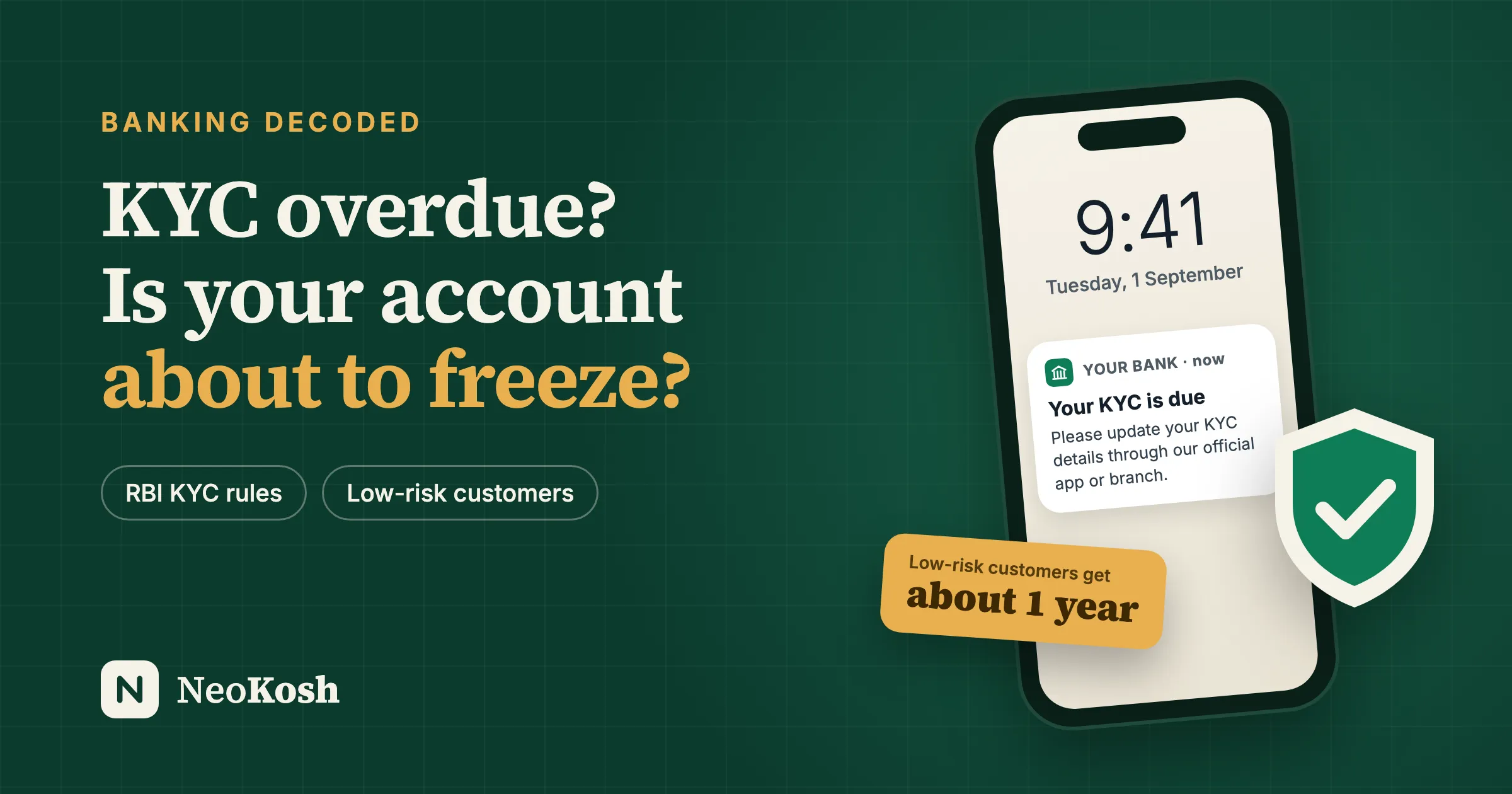
- An overdue KYC does not automatically freeze your account. For individuals your bank classifies as low-risk, RBI’s rules say transactions should continue while KYC is updated, generally for one year from the due date.
- Banks must send at least three notices before the due date and at least three reminders after it, with at least one letter in each set.
- If nothing has changed, a self-declaration through the bank’s app, internet banking, ATM, registered email or mobile, or a letter may be enough. No branch visit needed.
- The extra time is for updating KYC, not an exemption. Never share your OTP, PIN or password with anyone claiming to “update your KYC”.
In this article
A message saying “Your KYC is due” can make anyone nervous. And if the message says your account could be restricted, the worry becomes even bigger.
But does an overdue KYC automatically mean your bank account will be frozen?
Not always.
The Reserve Bank of India (RBI) introduced important changes to its KYC rules in 2025. One of the key changes gives certain low-risk individual customers more time to complete their KYC update, while requiring banks to give proper reminders before and after the due date.
First, what exactly is KYC?
KYC stands for Know Your Customer.
Banks collect information such as your identity and address so they can verify who is using an account and help prevent financial crime.
From time to time, customers may need to refresh this information. This is called periodic KYC updation.
However, not every customer is treated in exactly the same way. Banks classify customers into different risk categories, and the special protection discussed here applies specifically to individual customers classified as low-risk.
What happens when KYC becomes overdue?
Let’s take a simple example.
Suppose Meena has a savings account with ₹18,000 in it. Her bank has classified her as a low-risk individual, and her KYC becomes due on 1 September 2026.
A few days later, she needs to transfer ₹5,000 for her child’s school fees.
Does her account automatically stop working because the KYC due date has passed?
For an eligible low-risk individual, the answer is generally no.
The RBI rule provides a prescribed period during which transactions should continue while the KYC is updated. For newly due cases, this is generally one year from the date KYC becomes due. In Meena’s case, that would generally mean until 1 September 2027.
Meena’s KYC timeline
Before the due date
At least 3 advance notices
Sent at suitable intervals so Meena can update in time.
1 Sep 2026
KYC falls due
Prescribed period (generally 1 year)
Transactions continue
The ₹5,000 school-fee transfer can go through. At least 3 reminders if she still hasn’t updated.
1 Sep 2027
KYC should be updated by now
SMS, email or app noticeAt least one letter in each set
The important point is that this is time to complete KYC, not permission to ignore it.
Banks must give customers proper notice
Another important change is around communication.
Banks must provide:
- At least three advance notices before KYC becomes due
- At least three reminders after it becomes overdue
- At least one letter in each set of communications
So, if you receive a KYC reminder, don’t simply ignore it. The rule gives you time, but updating your records is still your responsibility.
Do you always need to visit the branch?
Not necessarily.
If none of your information has changed, you may be able to submit a self-declaration through approved channels such as your bank’s app, internet banking, ATM, registered email/mobile channel or letter.
If only your address has changed, the bank may allow you to declare the new address and should normally verify it within two months.
An authorised Business Correspondent (BC) may also help with eligible KYC updates.
Which route fits you?
If nothing has changed
Send a self-declaration
Confirm that your details are the same, through any approved channel:
- Bank app
- Internet banking
- ATM
- Registered email
- Registered mobile
- Letter
If only your address has changed
Declare the new address
The bank should normally verify it within two months, for example with a verification letter or visit.
If other details have changed
Ask your bank what it needs
The simple self-declaration route may not apply. Check which documents your bank requires.
An authorised Business Correspondent (BC) can also help with eligible updates. Whichever route you use, ask for an acknowledgement.
What about KYC fraud?
This is where customers need to be particularly careful.
A fraudster may send a message saying:
“Your KYC will expire today. Click this link immediately or your account will be blocked.”
Don’t panic.
Never share your OTP, PIN or password with anyone claiming to update your KYC.
Use your bank’s official app, website, branch or verified channel. If you use a Business Correspondent, make sure they are authorised and ask for an acknowledgement.
Spot the scam
+91 7X XXXX XXXXExample of a scam message
Dear customer, your KYC will expire TODAY. Click this link immediately kyc-update-now.example or your account will be blocked.
Red flags
- False urgency. Real banks send several notices over time, and low-risk customers generally get about a year after the due date.
- A link to click. Scammers use look-alike links to steal logins, OTPs and card details.
- A threat. Fear of losing access is meant to rush you into acting without checking.
Do this instead
- Open your bank’s official app or website yourself, or visit the branch.
- Never share your OTP, PIN or password, even with someone who says they’re from the bank.
- Using a Business Correspondent? Check they’re authorised and ask for an acknowledgement.
The bottom line
RBI’s KYC rules are trying to balance two things: protecting the banking system from misuse while ensuring genuine customers are not suddenly cut off from their money.
But remember: the special one-year protection is not an automatic extension for every customer. It applies to eligible low-risk individuals, and the exact treatment can depend on your risk classification and circumstances.
KYC is not just paperwork. It is one of the ways banks keep your money and the banking system safer.
At NeoKosh, we believe financial products and banking rules shouldn’t feel complicated. Our goal is to help people understand their money better, from fixed deposits and bonds to everyday financial decisions, so they can make informed choices with greater confidence.
Official sources
This article is for financial education and does not constitute investment, tax or legal advice.